Tell us about the job
Takes about a minute. No obligation.

A heat pump running through a long North Dakota winter puts its hardest work on the compressor and reversing valve, the two components that cycle every time the system shifts between heating and defrost mode. Homes in Sioux County, ND run heat about nine months a year, from September through May. By the time a contractor arrives for a repair, those parts have logged a season count that shows clearly in refrigerant pressure readings, amp draws, and valve response times. Worn contactor points and low refrigerant charge are common findings, and both trace directly to heating-side runtime rather than cooling load.
What a heat pump has been through is not always written on the outside. Half the homes in Sioux County, North Dakota were built in 1984 or earlier (2020-2024 ACS 5-year). Systems running in housing that old have often been swapped, patched, or rewired across multiple service cycles, and a contractor opening a unit here finds components whose actual condition sets the repair scope, not the brand name or whatever documentation the homeowner has. A part that looks standard on a quote sheet may have been substituted somewhere along the line, and what the opened unit holds is what drives the order.
The Parts of a Heat Pump a Contractor Checks First
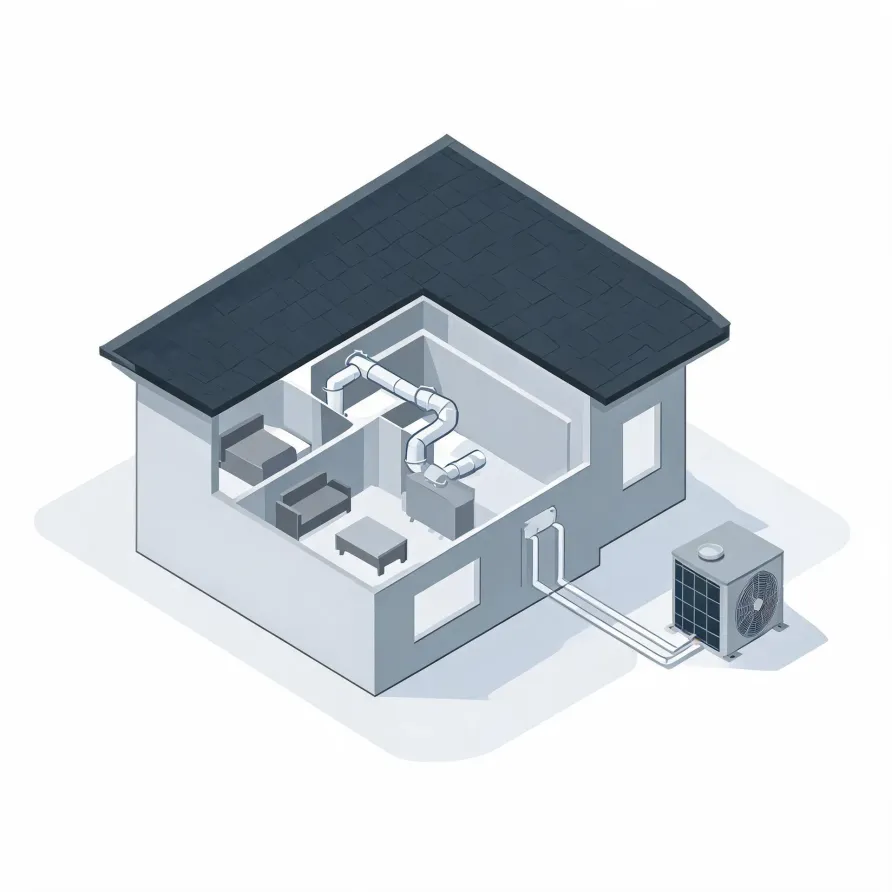
The outdoor unit sits on a pad beside the house and holds the compressor, which pressurizes the refrigerant and is the part a contractor goes to when the system stops heating or cooling altogether. The coil wrapped around that unit either pulls heat from the outside air or releases it, depending on the season, and a bent or iced-over coil is a common source of loss in both modes. The fan that draws air across that coil gets checked alongside it.
Inside the house, the air handler moves conditioned air into the living space and contains its own coil and blower motor, both of which a contractor inspects when airflow is weak or temperatures are uneven. The refrigerant lines connecting the two units run through the wall and carry the working fluid between them; a contractor looks for leaks or insulation damage along that path. The reversing valve inside the system is what switches it between heating and cooling, and it is a specific target when the system works in one direction but not the other.
The drawing shows a typical layout, and a licensed contractor determines which of these parts applies to the specific equipment and configuration in your home.
Find a contractor in Sioux CountySioux County by the Numbers
117 severe weather events were recorded in Sioux County, North Dakota between 2015 and 2024.
NOAA National Centers for Environmental Information, Storm Events Database, bulk CSV export, events 2015-01-01 through 2024-12-31.Half the homes in Sioux County, North Dakota were built in 1984 or earlier (2020-2024 ACS 5-year).
U.S. Census Bureau, 2020-2024 American Community Survey 5-Year EstimatesSioux County, North Dakota holds 1,280 housing units (2020-2024 ACS 5-year).
U.S. Census Bureau, 2020-2024 American Community Survey 5-Year EstimatesOwners occupy 46.6% of the occupied homes in Sioux County, North Dakota (2020-2024 ACS 5-year).
U.S. Census Bureau, 2020-2024 American Community Survey 5-Year EstimatesCodes & Standards Covering Heat Pump Repair in Sioux County, North Dakota1 sourced rules & standards
Licensing Rules for HVAC Repair in Sioux County, North Dakota
North Dakota requires a contractor licence once the cost, value or price of a job exceeds four thousand dollars, and an unlicensed contractor may not bring a claim or a lawsuit in a North Dakota court over the work.
Severe Weather Events in Sioux County
Extreme weather puts a real load on heat pump systems, and that load accumulates over time. How often conditions push equipment to its limits is a local fact, and it shapes what repair work looks like in Sioux County.
117 severe weather events, 2015–2024. Source: NOAA National Centers for Environmental Information, Storm Events Database.