Tell us about the job
Takes about a minute. No obligation.

A heat pump here runs its compressor hard through cold months, and the reversing valve cycles between heating and cooling more than most homeowners realize. Homes in Wells County, ND run heat about nine months a year, from September through May. That sustained heating demand is where the wear accumulates: the compressor works against falling outdoor temperatures, capacity drops, and the system cycles more frequently just to hold the house at setpoint. A contractor diagnosing a repair in this county checks the compressor first, then the reversing valve, because those are the parts the heating load grinds on. Refrigerant charge and the defrost board follow closely.
Ductwork in older houses carries the record of every system that ran through it, and when a heat pump fails, what the contractor finds inside the unit shapes the entire repair path. Half the homes in Wells County, North Dakota were built in 1964 or earlier (2020-2024 ACS 5-year). Housing that old has typically seen at least one equipment swap, which means the refrigerant circuit, the contactor, or the control board may be from a generation the original builder never anticipated. Parts for systems that have cycled through that many owners and that many retrofits are not always in a distributor's current catalog, and a contractor working a repair here checks availability before quoting a fix.
The Parts of a Heat Pump a Contractor Checks First
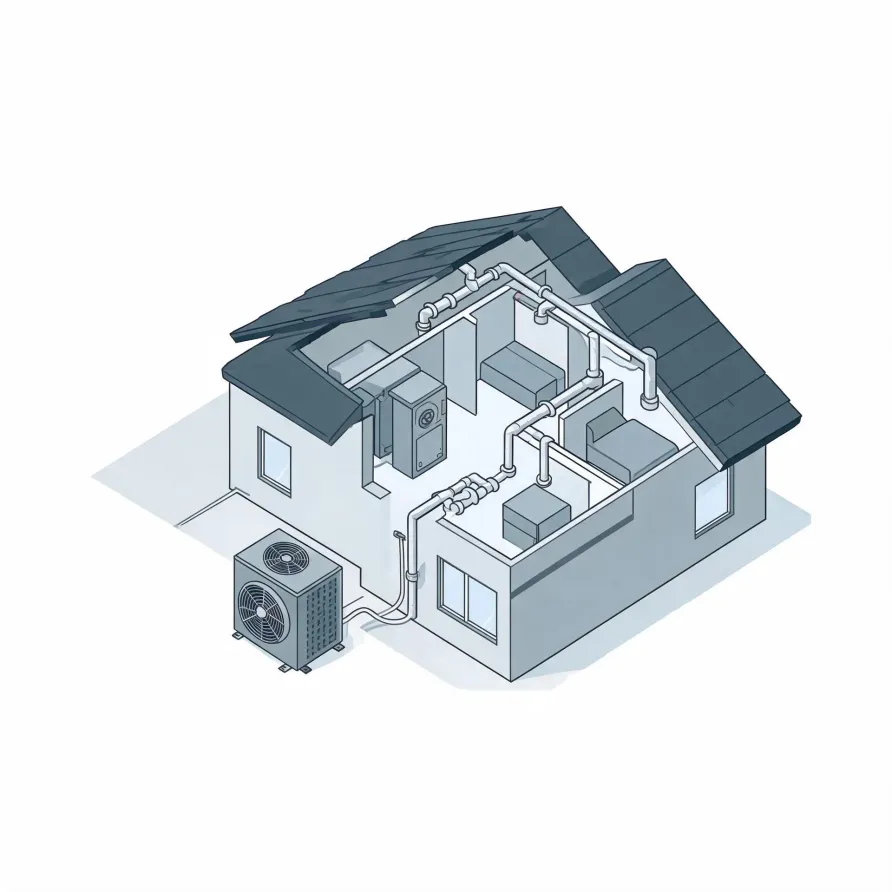
The outdoor unit sits outside the house and holds the compressor and the outdoor coil. The compressor is the part contractors reach for first when a heat pump stops moving heat altogether. The outdoor coil handles the exchange between refrigerant and outside air, and a bent, dirty, or iced-over coil is a common source of lost performance.
The air handler sits inside, usually in a utility closet or attic, and contains the indoor coil and the blower that pushes conditioned air through the house. The reversing valve, which lives in the outdoor unit, tells the system which direction to run, and a failed valve is what a contractor suspects when the system heats but will not cool, or the reverse. The refrigerant lines connecting both units carry the working fluid between them, and a leak anywhere along those lines shows up as reduced output at the registers.
The drawing shows a typical layout, and a licensed contractor determines which parts apply to your specific house and system.
Find a contractor in Wells CountyWells County, by the numbers
115 severe weather events were recorded in Wells County, North Dakota between 2015 and 2024.
NOAA National Centers for Environmental Information, Storm Events Database, bulk CSV export, events 2015-01-01 through 2024-12-31.Half the homes in Wells County, North Dakota were built in 1964 or earlier (2020-2024 ACS 5-year).
U.S. Census Bureau, 2020-2024 American Community Survey 5-Year EstimatesWells County, North Dakota holds 2,209 housing units (2020-2024 ACS 5-year).
U.S. Census Bureau, 2020-2024 American Community Survey 5-Year EstimatesOwners occupy 77.1% of the occupied homes in Wells County, North Dakota (2020-2024 ACS 5-year).
U.S. Census Bureau, 2020-2024 American Community Survey 5-Year EstimatesRepair Rules for Heat Pumps in Wells County, North Dakota1 sourced rules and standards
Licensing Rules for HVAC Repair in Wells County, North Dakota
North Dakota requires a contractor licence once the cost, value or price of a job exceeds four thousand dollars, and an unlicensed contractor may not bring a claim or a lawsuit in a North Dakota court over the work.
Severe Weather Events in Wells County, Year by Year
North Dakota weather puts real strain on heat pump systems, and Wells County conditions shape how hard local equipment has to work over time. Repair needs follow that workload, which is why weather history is relevant to anyone keeping a heat pump running here.
115 severe weather events, 2015–2024. Source: NOAA National Centers for Environmental Information, Storm Events Database.